

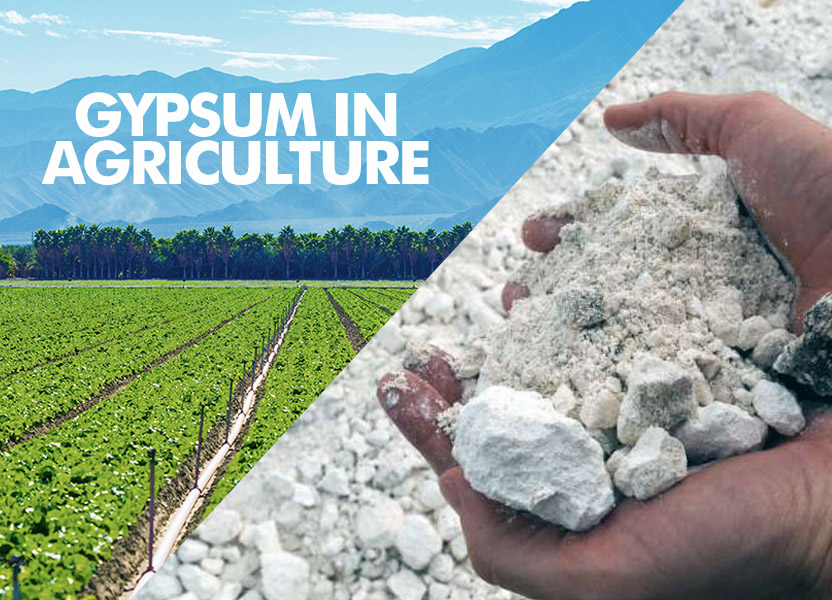
Gypsum is a moderately soluble source of the necessary plant nutrients, calcium & sulfur, and help overall plant growth. Gypsum plays more important roe in agriculture. It being a source of Calcium and Sulfur for plant nutrition and improving crop yield, Gypsum is very important in agriculture.
Gypsum improves Soil Structure and Nitrogen Uptake. Its main advantages is its ability to reduce aluminum toxicity, which often accompanies soil acidity, particularly in subsoil’s.
Gypsum application can improve root system establishment in low Ca and high Al soils resulting in higher nutrient uptake and greater yields. The combination of effect on some soils may improve yields and production efficiency synergistically by allowing more water to infiltrate and allowing roots to exploit water that is stored in subsoil horizons.
Clearly, gypsum application to soil can have multitude of impacts on both chemical and physical properties, which can ultimately affect crop production and environment quality. Many researchers have shown that gypsum can be used as a a soil conditioner to improve physical and chemical properties by promoting better aggregation, increasing water infiltration rate and movement through the profile, reclaiming sodic soils, mitigating subsoil acidity and aluminum (Al) toxicity and reducing soil and soluble phosphorus (P) loss from agricultural fields.